

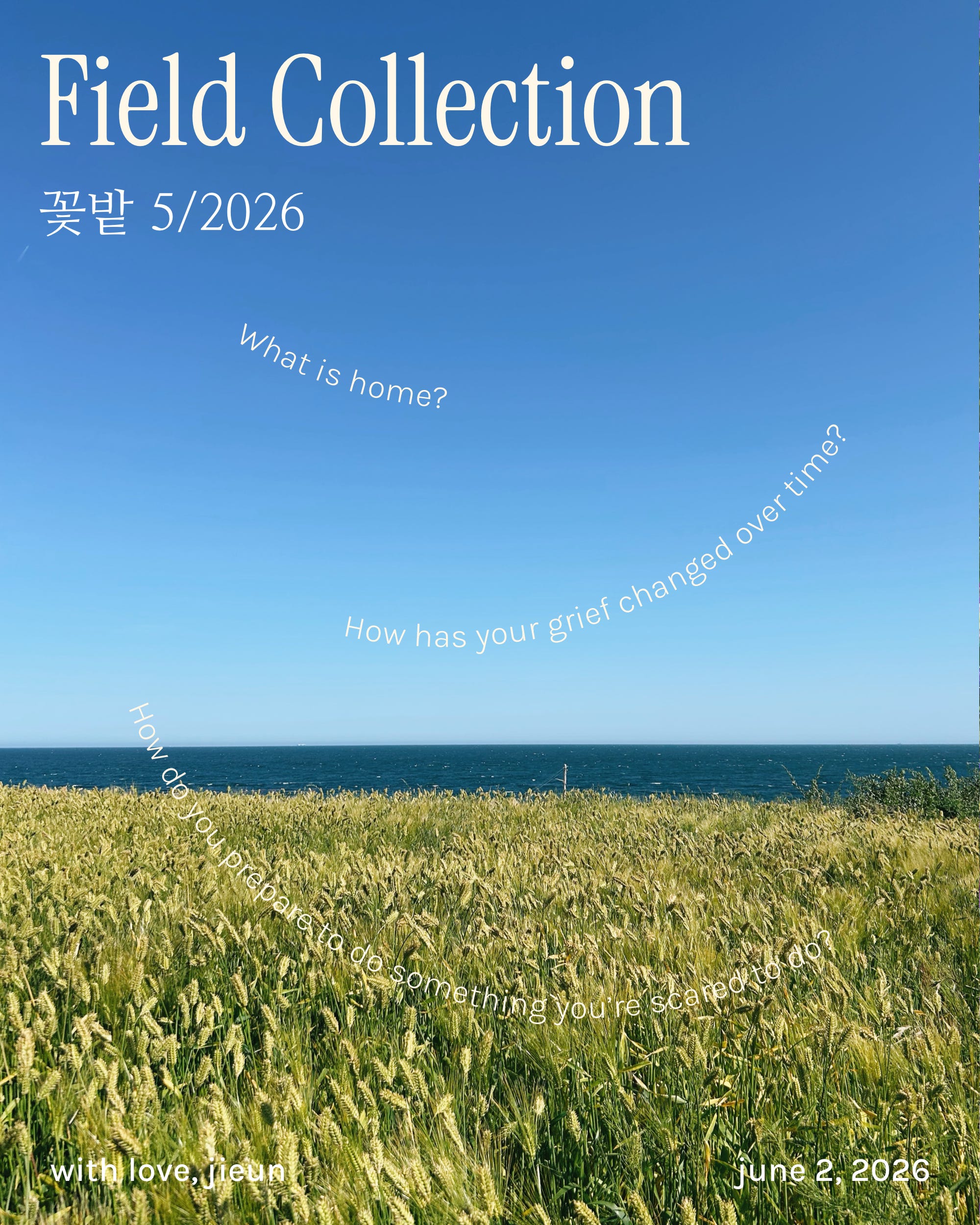
Field Collection • 꽃밭: 5/2026
What is home? How has your grief changed over time? How do you prepare to do something you're scared to do?

Flowers from the Field • 들꽃
Cities: 파주, 서울, 포항 • Paju, Seoul, Pohang
Town: 구룡포 • Guryongpo
Album: 응답하라 1988 사운드트랙 • Reply 1988 Original Soundtrack
Song: 이적 - 걱정말아요 그대 • Lee Juck - Don’t Worry
Store: 파도씨세탁소, Padosea Laundry • located in 죽도시장 in 포항
Magazine: 포포포 매거진, POPOPO
Flowers: 장미 rose, 무궁화 mugunghwa, 아이스플랜트 ice plant
Restaurant: 안동갈비, Andong Galbi • located in 포항시, 남구, 효자동
Book: Here After by Amy Lin
Conversation / Podcast #1: Thresholds Podcast — Amy Lin
Conversation / Podcast #2: The Creative Process Podcast — Hala Alyan, The Arsonists’ City
Artist: 박수철 작가님, a 76-year old self-taught artist and painter in 포항
Field Trip #1: 올앳동빈, ALL at Dongbin, located in 동빈문화창고1969
Field Trip #2: 꿈틀로 박수철 아틀리에 오픈 스튜디오 • Dream Road Park Su-cheol Open Studio
This is the art that inspired me during the fifth month of the year.
What art did you read, watch, listen to, and experience this month? What inspired you? What broke you? What moved you? What encouraged you? What questions did you ask? What answers did you find? What art did you make? What realizations did you have? What did you discover? Share your own field collections with me in the comments.
With love,
Jieun

Words of Encouragement • 응원
“Fields of grief.”
—Mary H.K. Choi
“Aren’t we all in this much pain?”
—Amy Lin
“Home travels with you. The cities we’ve lived in remember us.”
—Hala Alyan
“We become the stories we tell ourselves. What stories are you telling yourself?”
—Hala Alyan
“I would like people to remember what brought them here. There’s a whole legacy and lineage that precedes them. And sometimes that legacy is one of bloodshed, and sometimes that legacy is one of occupation. As long as we are aware of what our lineage is and what brought us to this specific moment, we can face and own our privileges, and we can face and own the ways in which we’ve been oppressed and marginalized and do the work, whatever we can, in community, and on our own, to try and change those stories.”
—Hala Alyan
“I’m suspecting the key is treating your own writing and your own life like a garden. And understanding that it’s going to be there tomorrow, and that you can invest in it. And that means, if you start planting tomorrow, you can pick up where you left off, and we’re going to be there every day, and no one is going to come and rush out over it, and it’s going to be okay. And when it’s time for harest, it’s going to be okay. And you notice — it’s going to be okay, it’s going to be okay, it’s going to be okay. How do we write when it’s going to be okay?”
—Ryka Aoki
“In a way, which I find very strange about grief — on the one hand, it feels like a great constriction in your life. But on the other hand, suddenly, it is as if anything could happen. It’s almost like, the worst has happened, therefore anything can happen. And that sense that things can be torn down and built up in an entirely different way, I think is part of how that character is operating. She suddenly moves, she has no attachments, she’s very much free-floating, and she’s adrift, and I think by the end of the book, she drops on anchor, and that signals, if not an end to her grief, then a kind of evolution of it to another phase.”
—Katie Kitamura
“When the last tree has been cut down, the last fish caught, the last river poisoned, only then will we realize that one cannot eat money.”
—Proverb of the Indigenous Cree Tribe, the native people of the unceded, ancestral lands of what was colonized by Europeans as Canada in 1534

Iman Mersel, translated by Lisa White, from “The Displaced Voice,” Belladonna* chaplet #232
“An accent only becomes a source of shame or anxiety when it signifies the lower status of the voice speaking to the ear listening. What determines status usually amounts to more than just the voice and its intention. It may be any of a number of relationships: that of the center to its periphery, of the colonizer to the colonized speaking his language, of the urban to the rural, or of the fortunate classes to those less privileged. I can’t imagine someone with an Oxford accent feeling ashamed when speaking to someone with one of England’s working class accents. Nor would a Parisian feel anxious listening to his accent side by side with that of an immigrant from Senegal. An accent is thus a transparent metaphor for relationships of power.”

Brown History: What is Diaspora Grief?
“For many people growing up in diaspora communities, relationships with extended family are shaped by distance from the very beginning. Grandparents or close relatives who are deeply important to your parents live in another country. You grow up knowing how much they matter, yet your own connection to them is limited. Love is present, but it is stretched thin across geography. By the time they pass away, the distance does not feel new, it has always been there, shaping how well you knew them.
When someone dies, the grief can feel disorienting. You know you have lost someone important, yet you may realize how little time you actually spent with them. There is sadness, but also guilt. You begin to think about the calls you postponed, the language you never fully learned, the stories you never asked to hear. What you are mourning is not only the person, but the relationship that never had the chance to fully form. This creates a specific kind of grief. A sense that something important has ended, even if you cannot fully name what it was.
At the same time, this experience is not separate from the immigrant story. It comes from it. The distance that shapes diaspora grief was created by a previous generation that left. They carried the immediate pain of separation and the diaspora inherits its long-term effects. In this way, grief becomes generational. The first generation mourned from afar, missing funerals and final moments. The next generation grows up with a quieter loss, shaped by partial connections and unfinished relationships. Absence becomes something normal, even expected.
For the diaspora, loss is not only about death, it is also about realizing how much of your family exists just beyond your reach, and how easily entire worlds and histories can fade when they are not lived up close. Grief, then, is not only an emotional experience, it is also a recognition of distance, and of everything that distance has already taken.”

Chloe Zhao, Academy Awards, Nomadland, 2021
“I’ve been thinking a lot lately about how I keep going when things get hard, and I think it goes back to something I learned when I was a kid. When I was growing up in China, my dad and I used to play this game. We would memorize classic Chinese poems and texts, and we would recite it together and try to finish each other’s sentences. And there’s one that I remember so dearly — it’s called, “The Three Character Classics.” And the first phrase goes: 人之初,性本善 (rén zhī chū, xìng běn shàn). People at birth, are inherently good.” And those six letters had such a great impact on me when I was a kid, and I still truly believe them today. Even though sometimes it might seem like the opposite is true, I have always found goodness in the people I have met, everywhere I went in the world. So this is for anyone who has the faith and the courage to hold onto the goodness in themselves, and to hold onto the goodness in each other, no matter how difficult it is to do that. This is for you. You inspire me to keep going. Thank you.”

Questions • 질문
What is home?
How has your grief changed over time?
How do you prepare to do something you’re scared to do?
How does your grief continue to come up in your life?
What stories are you telling yourself?
How do we trace the roots of our pain?